
Know where your riskis building.

Connect the portfolio view to the account, counterparty and trade behind it. Review limit usage, execution changes and stress scenarios with the evidence needed to decide what deserves attention.

Contact

Explore the foundation

Risk / Connected exposures

See how a venue event affects connected accounts.

Scenario inputCounterparty stressVENUE A
AccountCollateralAvailability changes
AccountOpen ordersReserved capacity
Portfolio / StrategyExposure under the scenarioAssumptions and affected entities attached
Assess impactAssign the review
Scenario results depend on the selected inputs and stress assumptions.
01

Exposure across connected accounts

02

Execution changes with supporting evidence

03

Risk cases assigned for review

Product view

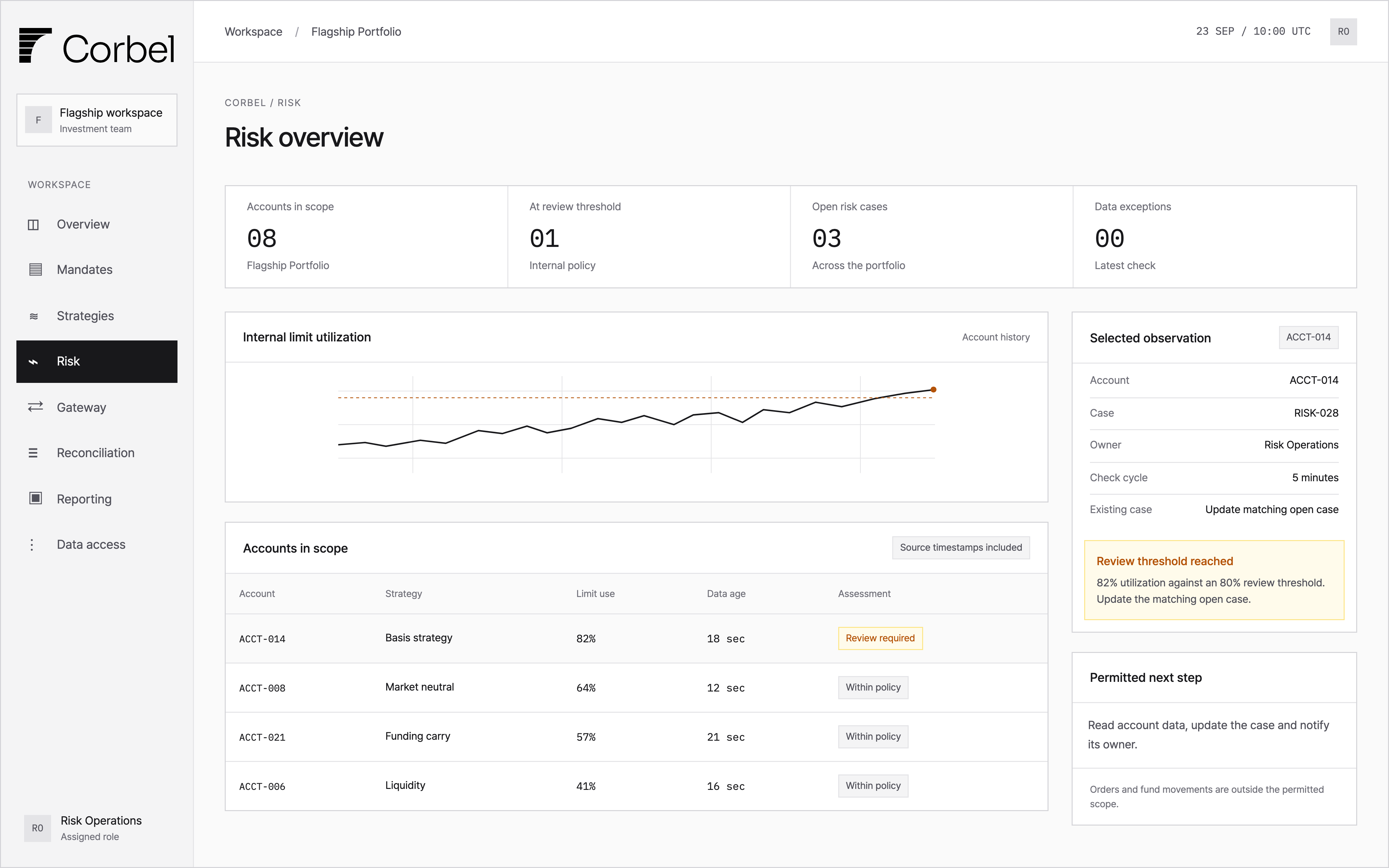
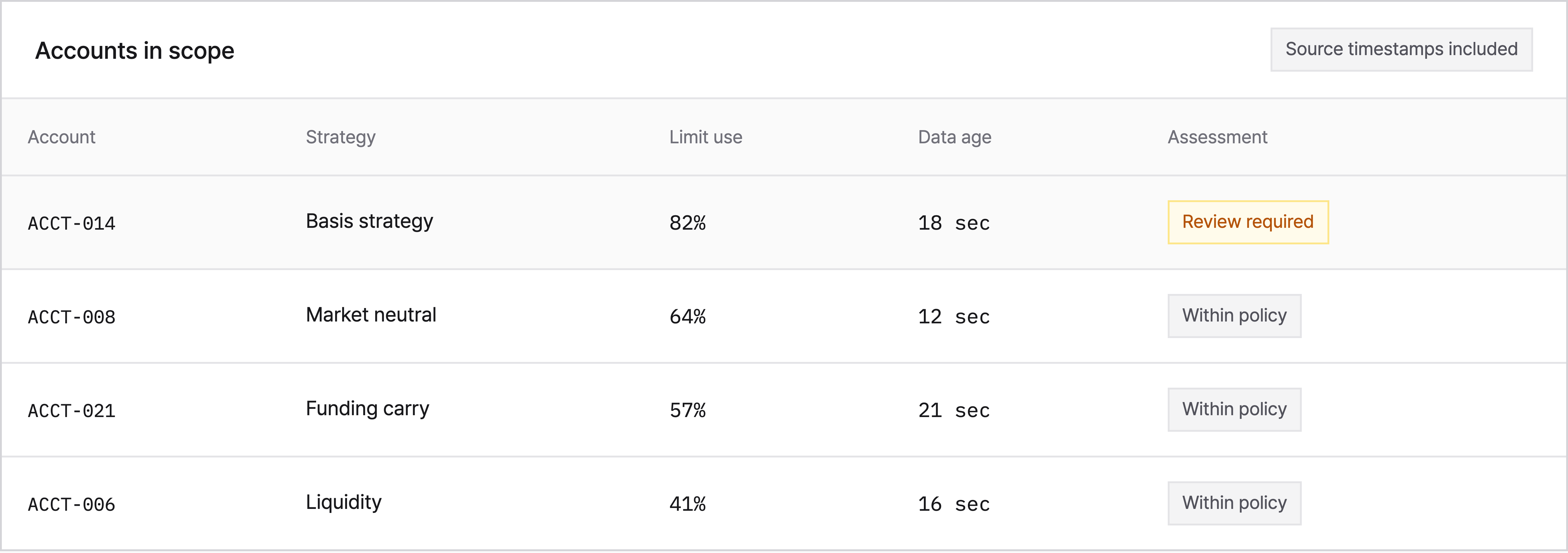
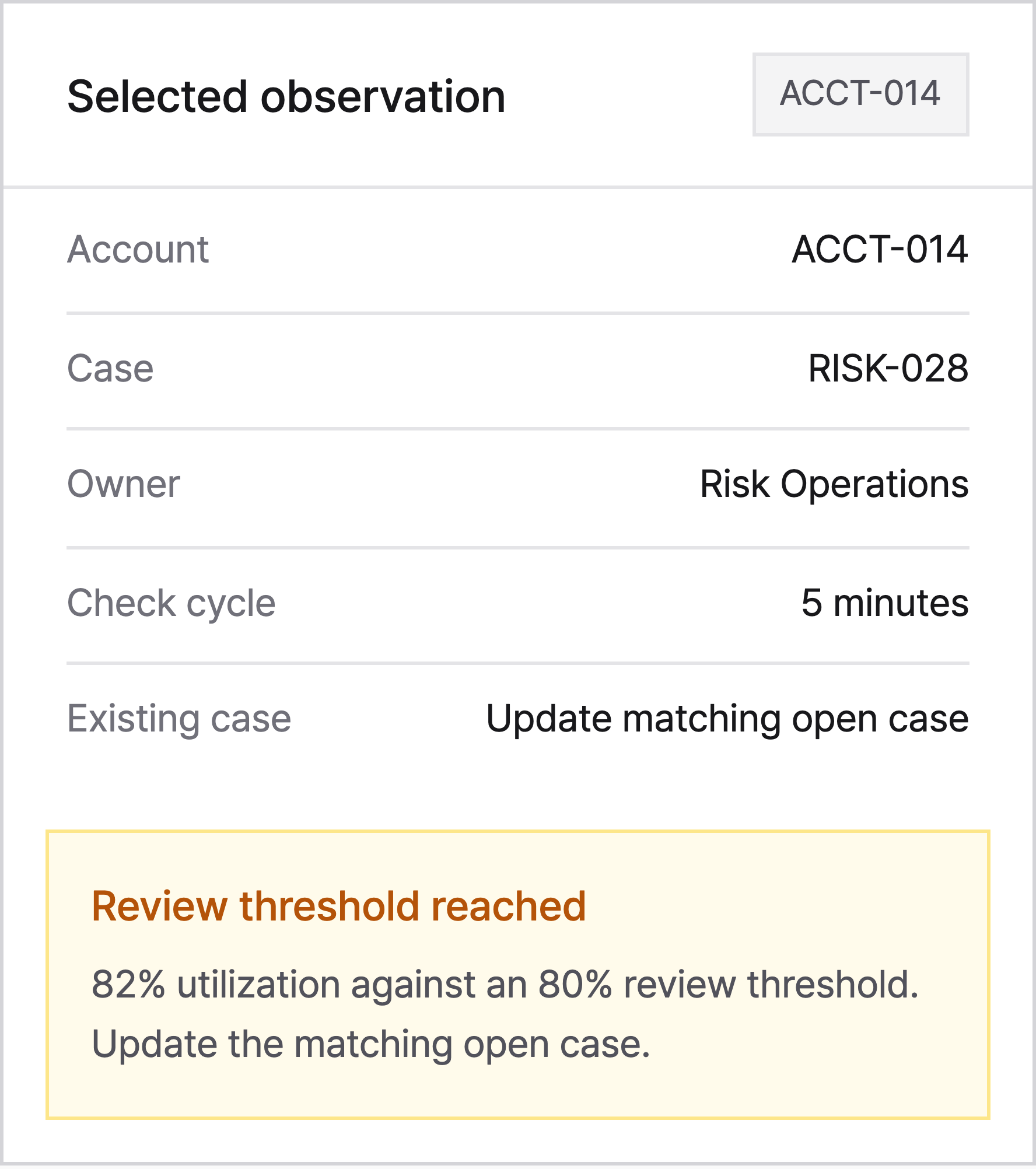
Trace a risk finding to its account and policy.

Move from the portfolio view to the account, policy and review case behind an observation.

risk workspace showing a Flagship Portfolio account at 82 percent utilization, a review threshold and an existing case assigned to Risk Operations.
Portfolio to account
Freshness beside the number
Case context in view

What it covers

The same position can carry more than one kind of risk.

A venue event can affect collateral, account headroom and several strategies at once. Investigate whether changes in fills reflect liquidity, costs or signal decay, and which accounts and strategies are affected.

Monitor current exposures

Review portfolio, strategy, counterparty and account exposure against the appropriate policy. Include data freshness and unresolved cases in the assessment.

  • Exposure, concentration, collateral and limit usage
  • Portfolio / strategy / counterparty / account views
  • Freshness checks and deduplicated risk cases

Investigate execution changes

Compare transaction costs and post-trade results using agreed benchmarks. Investigate changes in orders, cancellations, fills and signal decay with enough context to distinguish a pattern from a data problem.

  • Transaction cost analysis (TCA) with agreed benchmarks, fees and timing definitions
  • Post-trade analysis by venue, instrument and strategy
  • Order, fill, cancellation and alpha-decay pattern review

Test a defined stress scenario

Use entity relationships to examine how a counterparty or collateral event could affect other accounts and strategies. Keep the scenario assumptions separate from observed facts.

  • Ontology-linked risk scenarios
  • Historical and hypothetical stress tests
  • Affected entities, assumptions and response owners

In practice

Turn a limit observation into an owned risk case.

An account reaches 82% utilization against an 80% review threshold. Corbel checks the source timestamp, updates the matching open case and notifies Risk Operations. Stale data goes to a data check instead of a normal assessment.

01

Observe

Check the configured accounts every five minutes.

02

Evaluate

Check the limit and the 60-second freshness rule.

03

Assign

Update the matching case and notify its owner.

04

Record

Retain the evidence and response without orders or transfers.

Implementation

Plan your implementation.

Define the inputs, responsibilities and checks for your operation.

Your inputs
Limits, benchmarks, stress assumptions and escalation owners.
Corbel configures
Calculations, relationship models, monitoring and investigation views.
Validation & controls
Validate coverage, freshness, calibration and exception handling.

Corbel, configured for you

We connect your portfolio to the controls it needs.

Share your data sources and risk priorities. We’ll map the exposures, checks and responsibilities to monitor.

Contact

Your privacy

Cookie settings

Choose whether to allow optional analytics on this website.

Your saved choice

Essential

When available, browser storage remembers your choice. This preference is kept in your browser and is not sent to an analytics provider.

Optional analytics

Off

Optional analytics is not enabled on this site.